
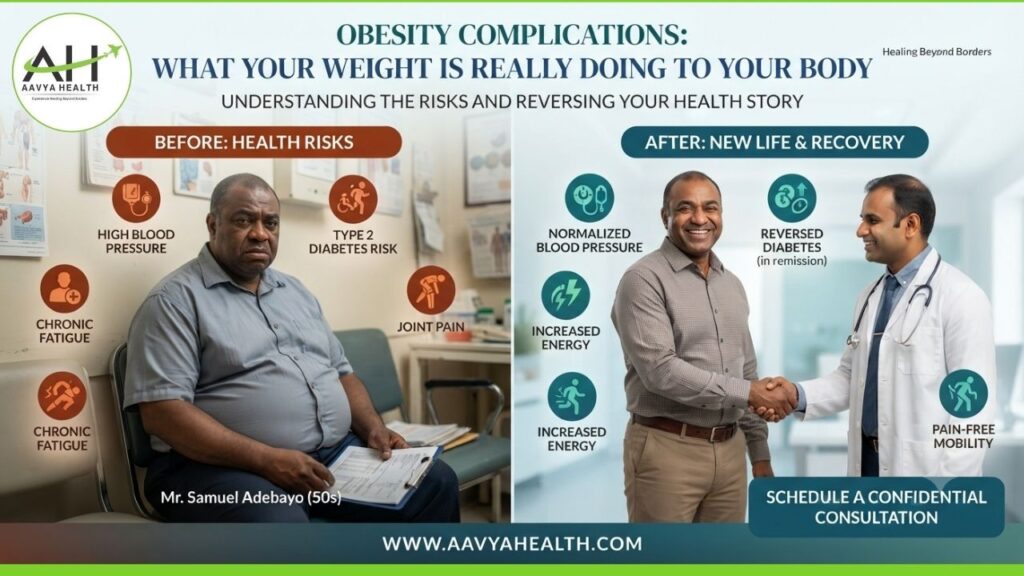
“Obesity is not a character flaw or a matter of willpower — it is a chronic, complex disease. And like all diseases, it has real, measurable consequences on nearly every organ in your body.”
What Exactly Is Obesity?
Most people think obesity simply means being “very overweight.” But medically, obesity is defined as an excess accumulation of body fat that actively endangers your health. It is classified as a chronic disease — just like diabetes or hypertension — and it behaves like one too: it progresses silently, worsens over time without treatment, and increases the risk of dozens of other serious conditions.
The most widely used screening tool is the Body Mass Index (BMI) — a number calculated from your height and weight. While BMI isn’t a perfect measure (it doesn’t distinguish between muscle and fat, for instance), it gives doctors a reliable, consistent starting point.
BMI Classification Chart:
| BMI Range | Classification | Health Risk |
| Below 18.5 | Underweight | Increased |
| 18.5 – 24.9 | Normal weight | Low |
| 25 – 29.9 | Overweight | Moderate |
| 30 – 34.9 | Obesity Class I | High |
| 35 – 39.9 | Obesity Class II | Very High |
| 40 and above | Obesity Class III (Severe) | Extremely High |
Important note for South Asians: Indian and South Asian bodies tend to accumulate dangerous visceral (belly) fat at lower BMI values than Western populations. Most Indian doctors use adapted thresholds — BMI ≥ 23 for overweight and BMI ≥ 27.5 for obesity — because the metabolic risks appear earlier in our population.
If you’re Indian and your BMI is above 23, it’s worth a conversation with your doctor.
Why Does Obesity Happen? It’s Not Just About Food
Before we get into complications, it’s important to understand one thing clearly: obesity is not simply the result of eating too much or exercising too little.
It is a complex disease driven by a combination of:
– Genetics — your genes influence how your body stores fat, responds to food, and regulates hunger hormones like leptin and ghrelin
– Hormonal imbalances — conditions like hypothyroidism, PCOS, and Cushing’s syndrome directly cause weight gain
– Sleep deprivation — poor sleep raises hunger hormones and lowers metabolic rate
– Stress and mental health — chronic stress elevates cortisol, which drives fat storage, particularly around the abdomen
– Gut microbiome — the bacteria in your intestines influence how many calories you absorb from food
– Medications — steroids, antidepressants, antipsychotics, and insulin can cause significant weight gain
– Environment and socioeconomics — access to healthy food, safe spaces to exercise, and working hours all matter enormously
Understanding this is not about making excuses — it’s about making the right treatment plan. Telling someone to “just eat less” when their thyroid is underactive or their cortisol is chronically elevated is like telling someone with a broken leg to “just walk it off.”
10 Serious Complications of Obesity
This is where obesity becomes a genuine medical emergency for many people. Excess body fat doesn’t just sit there — it is metabolically active, constantly releasing hormones, inflammatory chemicals, and fatty acids that damage organs throughout the body. Here are the ten most significant complications:
1. Heart Disease & High Blood Pressure ❤️
Risk Level: Very High
Excess body fat — especially visceral fat around the abdomen — forces the heart to pump blood through a vastly expanded network of blood vessels. Over time, this raises blood pressure, thickens the walls of the heart, stiffens arteries, and dramatically increases the risk of heart attack and stroke.
Obesity is also closely linked to dyslipidaemia — dangerously high triglycerides and low “good” (HDL) cholesterol — which accelerates plaque build-up inside arteries. Studies show that obese individuals have up to *three times the cardiovascular risk* of people at a healthy weight.
2. Type 2 Diabetes
Risk Level: Very High
The link between obesity and Type 2 diabetes is one of the strongest associations in all of medicine. Visceral fat causes insulin resistance — the body’s cells stop responding properly to insulin, so blood sugar rises, the pancreas works overtime to compensate, and eventually it burns out.
Over 80% of people diagnosed with Type 2 diabetes are overweight or obese. Conversely, losing even 5–10% of body weight can dramatically improve or — in some cases — fully reverse Type 2 diabetes in its early stages.
3. Sleep Apnea
Risk Level: Very High
Sleep apnea is a condition in which breathing repeatedly stops and starts during sleep. In people with obesity, fat deposits around the neck and upper airway cause the airway to collapse when muscles relax during sleep — sometimes hundreds of times per night.
Each episode briefly starves the brain and heart of oxygen. Over time, untreated sleep apnea significantly raises the risk of heart disease, stroke, high blood pressure, and type 2 diabetes. Many people with sleep apnea don’t even know they have it — they just know they wake up exhausted every single morning.
4. Osteoarthritis & Joint Pain
Risk Level: High
Your joints — especially the knees, hips, and lower back — were not designed to bear unlimited weight. Research shows that every extra 1 kg of body weight adds approximately 4 kg of force on the knee joint with each step.
Over years and decades, this excess mechanical stress grinds down cartilage faster than the body can repair it, leading to chronic osteoarthritis. The pain limits movement, movement limitation reduces calorie burn, and a vicious cycle begins. Joint pain from obesity is one of the leading reasons people stop exercising — making the underlying problem worse.
5. Non-Alcoholic Fatty Liver Disease (NAFLD)
Risk Level: Very High
You don’t have to drink alcohol to develop serious liver disease. When excess fat accumulates inside liver cells, it causes inflammation and scarring in a condition called Non-Alcoholic Fatty Liver Disease (NAFLD). It is now the most common cause of chronic liver disease worldwide — and most people have no symptoms until it has already progressed.
Left untreated, NAFLD can advance to non-alcoholic steatohepatitis (NASH), cirrhosis, liver failure, and liver cancer. The good news: it is often reversible with meaningful weight loss in its earlier stages.
6. Mental Health & Depression
Risk Level: High
The relationship between obesity and mental health runs in both directions. On one hand, obesity — and particularly the social stigma around it — significantly increases the risk of depression, anxiety, low self-esteem, and social withdrawal. On the other hand, depression often leads to comfort eating, reduced activity, and disrupted sleep — all of which promote weight gain.
Obesity also affects brain chemistry directly. Chronic inflammation from excess fat tissue crosses the blood-brain barrier and alters neurotransmitter function. This is not “feeling sad about your weight” — it is a physiological process with measurable consequences for mental wellbeing.
7. Certain Cancers
Risk Level: Very High
This is perhaps the least talked-about — and most alarming — complication of obesity. Excess body fat is a recognised risk factor for at least 13 types of cancer, including:
– Breast cancer (post-menopausal)
– Colorectal cancer
– Endometrial (uterine) cancer
– Kidney cancer
– Pancreatic cancer
– Oesophageal cancer
– Gallbladder cancer
Fat tissue produces excess oestrogen, insulin-like growth factors, and inflammatory chemicals — all of which create an environment that encourages abnormal cell growth and suppresses the immune surveillance that normally catches cancer early.
8. Reproductive & Hormonal Disruption
Risk Level: High
In women, obesity disrupts the delicate hormonal balance that regulates the menstrual cycle. It is a primary driver of Polycystic Ovary Syndrome (PCOS) — causing irregular periods, excess androgens, and difficulty conceiving. During pregnancy, obesity significantly raises the risk of gestational diabetes, preeclampsia, miscarriage, and complicated delivery — for both mother and baby.
In men, excess fat converts testosterone to oestrogen through a process called aromatisation, leading to low testosterone, reduced fertility, erectile dysfunction, and loss of muscle mass.
9. Chronic Kidney Disease
Risk Level: High
The two leading causes of kidney failure — high blood pressure and Type 2 diabetes — are both strongly driven by obesity. The kidneys are high-pressure filtration organs; sustained damage from hypertension and high blood sugar gradually destroys the tiny filtering units (nephrons) that cannot regenerate. Early-stage kidney damage has no symptoms, making routine monitoring essential for anyone with obesity.
10. Chronic Systemic Inflammation
Risk Level: Very High
This is the thread that ties everything else together. Fat tissue — particularly visceral fat — is not passive storage. It is an active endocrine organ that continuously releases pro-inflammatory chemicals including TNF-alpha, interleukin-6, and C-reactive protein into the bloodstream.
This persistent, low-grade inflammation is the common biological mechanism behind most of obesity’s complications — from insulin resistance to atherosclerosis to cancer. It is why treating obesity is not just about aesthetics; it is about turning off a chronic inflammatory fire that is quietly damaging your body every single day.
“Losing just 5 to 10% of your body weight — that’s 5 kg for a 70 kg person — can meaningfully reduce blood pressure, blood sugar, cholesterol, and joint pain. You don’t need to reach a perfect weight to benefit. You just need to start.”
Warning Signs You Should Not Ignore
Obesity-related complications often develop silently. These symptoms suggest damage may already be underway:
– Waking up exhausted* despite sleeping 7–8 hours (possible sleep apnea)
– Fasting blood sugar above 100 mg/dL (prediabetes territory)
– Persistent knee or back pain that limits daily activity
– Frequent heartburn or acid reflux (sign of GERD, worsened by obesity)
– Breathlessness climbing one flight of stairs (cardiovascular or respiratory strain)
– Irregular periods or difficulty conceiving (PCOS, hormonal disruption)
– Dark, velvety skin patches on the neck, armpits, or groin (acanthosis nigricans — a classic sign of insulin resistance)
– Elevated ALT/AST on blood work without alcohol use (early NAFLD)
– Persistent low mood, fatigue, or loss of interest in activities you once enjoyed
If you recognise three or more of these, please don’t wait. Get a comprehensive evaluation.
What Can You Actually Do About It?
The most important thing to understand is this: obesity is a treatable medical condition. Modern evidence-based medicine offers far more than generic “diet and exercise” advice. Here is what a structured approach actually looks like:
Step 1 — Medical Assessment
Before anything else, rule out underlying hormonal causes (thyroid disorders, PCOS, Cushing’s syndrome) and assess your current complication risk. This includes fasting blood sugar, HbA1c, lipid panel, liver enzymes, kidney function, and blood pressure — not just stepping on a scale.
Step 2 — Personalised Nutrition
There is no single “best diet” for everyone. A registered clinical dietitian can build a culturally appropriate, sustainable eating plan around your food preferences, medical conditions, work schedule, and lifestyle. The goal is not starvation — it is intelligent, lasting change.
Step 3 — Structured Physical Activity
The evidence-based minimum is 150 minutes of moderate activity per week — but the best exercise is the one you will actually do consistently. Even 10-minute walks after meals meaningfully reduce blood sugar. Start where you are, not where you think you should be.
Step 4 — Behavioural & Psychological Support
Emotional eating, stress, poor sleep, and self-sabotage are real obstacles that diet plans alone cannot address. A health counsellor or psychologist can help you identify and work through the behavioural patterns that make sustained weight loss so difficult for so many people.
Step 5 — Medical & Surgical Options (Where Appropriate)
For patients with BMI ≥ 30 with complications, or BMI ≥ 35, evidence-based medical options exist:
– GLP-1 medications (semaglutide, liraglutide) have shown 15–20% body weight reduction in clinical trials, along with dramatic improvements in blood sugar, blood pressure, and cardiovascular risk
– Bariatric surgery (sleeve gastrectomy, gastric bypass) offers the most powerful long-term results for severe obesity, including Type 2 diabetes remission rates exceeding 80% in some studies
These are medical decisions that must be made with a qualified physician — but they are real, effective options that more patients deserve to know about.
Frequently Asked Questions
Q: Is obesity just about eating too much?
No. Obesity is a multifactorial chronic disease shaped by genetics, hormones, gut microbiome, medications, sleep, stress, and environment. Reducing it to “eating too much” is both scientifically inaccurate and clinically counterproductive.
Q: Can the complications of obesity be reversed?
Many can — especially when caught early. Type 2 diabetes can go into remission. Fatty liver can resolve. Blood pressure and cholesterol can normalise. Sleep apnea can disappear. The earlier you act, the more reversible these complications are.
Q: How much weight loss is actually needed to see benefits?
Research consistently shows that losing 5–10% of body weight produces significant, measurable improvements in blood pressure, blood sugar, cholesterol, inflammation, and joint pain. You do not need to reach an “ideal” BMI first.
Q: Are weight loss medications safe?
Modern GLP-1 medications have been extensively studied in large clinical trials and are considered safe for eligible patients. Like all medications, they carry individual risk profiles and must be prescribed and monitored by a qualified physician.
Q: Does BMI work the same way for Indians?
No. South Asians develop metabolic disease at lower BMI levels. Indian clinical guidelines recommend using BMI ≥ 23 as overweight and ≥ 27.5 as obese for our population.
Q: Is bariatric surgery dangerous?
Modern bariatric surgery, performed by experienced surgeons, has a safety profile comparable to routine gallbladder surgery. The risk of not treating severe obesity — with its impact on heart disease, diabetes, and cancer risk — typically far outweighs the surgical risk for eligible patients.
The Bottom Line
Obesity is not a personal failure. It is a complex, chronic, and progressive disease — and it is one of the most consequential health challenges of our time. Left unaddressed, it silently drives heart disease, diabetes, cancer, liver failure, joint destruction, and a diminished quality of life.
But it is also one of the most responsive conditions to treatment. With the right medical support, the right team, and the right plan — built around you — meaningful change is not just possible. For thousands of patients, it has already happened.
The first step is always the hardest. But it is also the most important.
At Aavya Health, our team of physicians, dietitians, and health coaches works with you — not at you — to build a plan that fits your body, your life, and your goals.
Book a consultation today at www.aavyahealth.com
Disclaimer: This article is for informational and educational purposes only. It does not constitute medical advice. Please consult a qualified healthcare professional for diagnosis and treatment.




Aavya Health, where our unwavering commitment to precision and excellence sets us apart as a leading medical assistance company.
As a dedicated team of professionals, we understand the significance of accurate and reliable medical assistance. Our team of skilled professionals, including medical experts, technologists, and support staff, works tirelessly to ensure that every aspect of our services meets the highest standards of quality and precision.
Whether you are seeking diagnostic support, personalized health advice, or assistance in navigating complex medical information, Aavya Health is here for you.
We strive to be your trusted partner in health, offering solutions that are not just accurate but also tailored to your unique needs.
Join us on this journey towards a healthier and more informed future, where patient’s well-being is our priority.
India is a first choice due to its world-class healthcare infrastructure, highly skilled medical professionals, advanced treatments, and cost-effective services.
You can trust us you’ll receive expert guidance and personalized support at every step in selecting the right hospital for your treatment. Because your health and well-being are our top priorities.
At Aavya Health our case manager, always prioritizes the comfort, convenience, and well-being of our international patients, and we go above and beyond to ensure that their needs are met with personalized care.
Medical treatments in India are often significantly more affordable compared to other countries, offering cost savings of up to 70% to 80% without compromising on quality or expertise.
Aavya Health case manager will streamline the process, Simply provide us with your medical needs and preferred dates, and our dedicated team will handle all aspects of appointment scheduling, travel logistics, and accommodation, ensuring a hassle-free experience for you. With our expertise and network of trusted partners, we ensure that your medical journey to India is smooth, efficient, and stress-free.
Note: AavyaHealth does not offer medical advice, diagnosis, or treatment. The services and information provided on www.aavyahealth.com are solely for informational purposes and cannot substitute professional consultation or treatment by a physician. AavyaHealth discourages copying or cloning of its webpages and content, and will take legal action to protect its intellectual property.